
Sustainability, Trust and the Say-Do Gap: FFIND Presents Data Pulse at the European Parliament
Why a Data Collection Company Decided to Launch an Independent Sustainability Study
You don’t usually picture a data collection company on a stage at the European Parliament, right?
And yet, on May 12th, there we were.
Our CEO Ennio Armato presented our Sustainability Study 2026 at the Esomar Citizen Insights Summit – Democracy in Focus; an event organized by Esomar, co-organized with the European Parliament.
Now, you might be asking: why would a data collection company invest time and money into a study on sustainability? No client asked for it. No one paid for it.
Here’s the backstory.
In 2026, we started our own sustainability journey. Small steps. We’ve published our first sustainability report. We set goals — as a company and as people. And then we asked ourselves: what is the most meaningful thing a data collection company can do right now?
The answer felt simple. The most meaningful: give people a voice.
That’s how Data Pulse was born: an ongoing series of proprietary, independent, pro bono research on the topics that are actually shaping our world and lives. Not research driven by a client brief.
The Sustainability Study 2026 is its first edition.

Sustainability in Europe: Between Awareness, Greenwashing and Everyday Behaviour
Everyone talks about sustainability and greenwashing these days. Companies publish ESG reports. Governments pass directives. Consumers say they care. The vocabulary of environmental commitment has never been so widespread.
We live in a moment where the distance between what is said and what is done has never been more consequential. Climate targets are being set. Deadlines are approaching. And yet the gap between institutional ambition, corporate narrative and citizen reality remains largely unmeasured and largely unspoken.
We wanted to know what was actually happening beneath the surface, not in boardrooms or policy documents, but in the minds and daily habits of people. Just five simple lenses:
- Awareness
- Concerns
- Behaviours and self-efficacy
- Barriers & Responsibilities
- Future Intentions
We conducted this research in March 2026 across France, Germany, Italy, Spain and the United Kingdom. 1,000 people per country, aged 18+. 5,000 interviews in total.
We combined 80% CATI (Computer Assisted Telephone Interviews) and 20% CAWI (Computer Assisted Web Interviews).
The choice was deliberate — and intentional.
Why? Because each method tells you something.
When someone is on the phone with an interviewer, they tend to present themselves in a better light — overstating virtuous behaviours, understating inaction. Researchers call this social desirability bias, and it is particularly acute on topics like sustainability.
Neither methodology is “better.” Together, they give us a fuller picture.

Sustainability Awareness in Europe Remains Surprisingly Low
Before asking what people do, we asked what they know. Across five European countries — France, Germany, Italy, Spain and the UK — fewer than 4 in 10 people feel informed about environmental sustainability. This is a continent that talks about climate action more intensely than any other region on earth. Germany reports the highest level of self-perceived awareness. There, 37.3% of people say they feel informed. In Spain, the figure drops to 20.6%.
And when it comes to greenwashing — one of the most debated concepts in contemporary sustainability discourse — the picture is equally telling. Only 59% of UK respondents know the term, the highest across the five countries. In Spain, that drops to 31.7%. But knowing the word is one thing. Being able to define it correctly is another: across all countries, correct definitions remain a minority — from 45% in the UK down to 19.4% in Spain.
Greenwashing and Distrust: Why Sustainability Communication Is Losing Credibility
Three in four Europeans don’t believe a word companies say about sustainability. Not three in ten. Three in four. And this isn’t a generational thing, or a cultural one — it cuts across age groups, education levels and five very different national contexts with a consistency that should make anyone in communications or ESG role deeply uncomfortable.
This isn’t a recent wound. It’s been building for years — through claims that couldn’t be verified, certifications nobody understood, and campaigns that felt less like commitment and more like reputation management.
And when trust breaks at this scale, people don’t just shrug. They act.
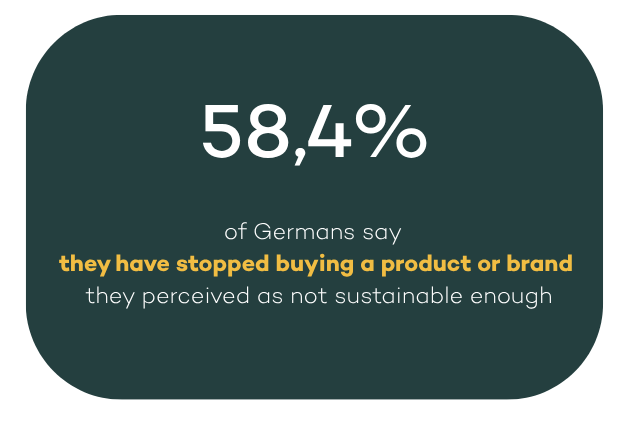
More than half of Europeans say they have already boycotted a brand for sustainability reasons. Not that they would consider it. That they have done it — between 51.9% in Spain and 58.4% in Germany. And if they discovered a company was actively engaged in greenwashing, the response would be even sharper: 73.7% of Spanish consumers would stop purchasing immediately. Even in France — the most forgiving of the five countries — that figure sits at 48.5%.
The sectors feeling this most are Fast Fashion and FMCG. Not coincidentally, they are the industries where the gap between what companies say and what they actually do is most visible, most documented, and most present in everyday life.
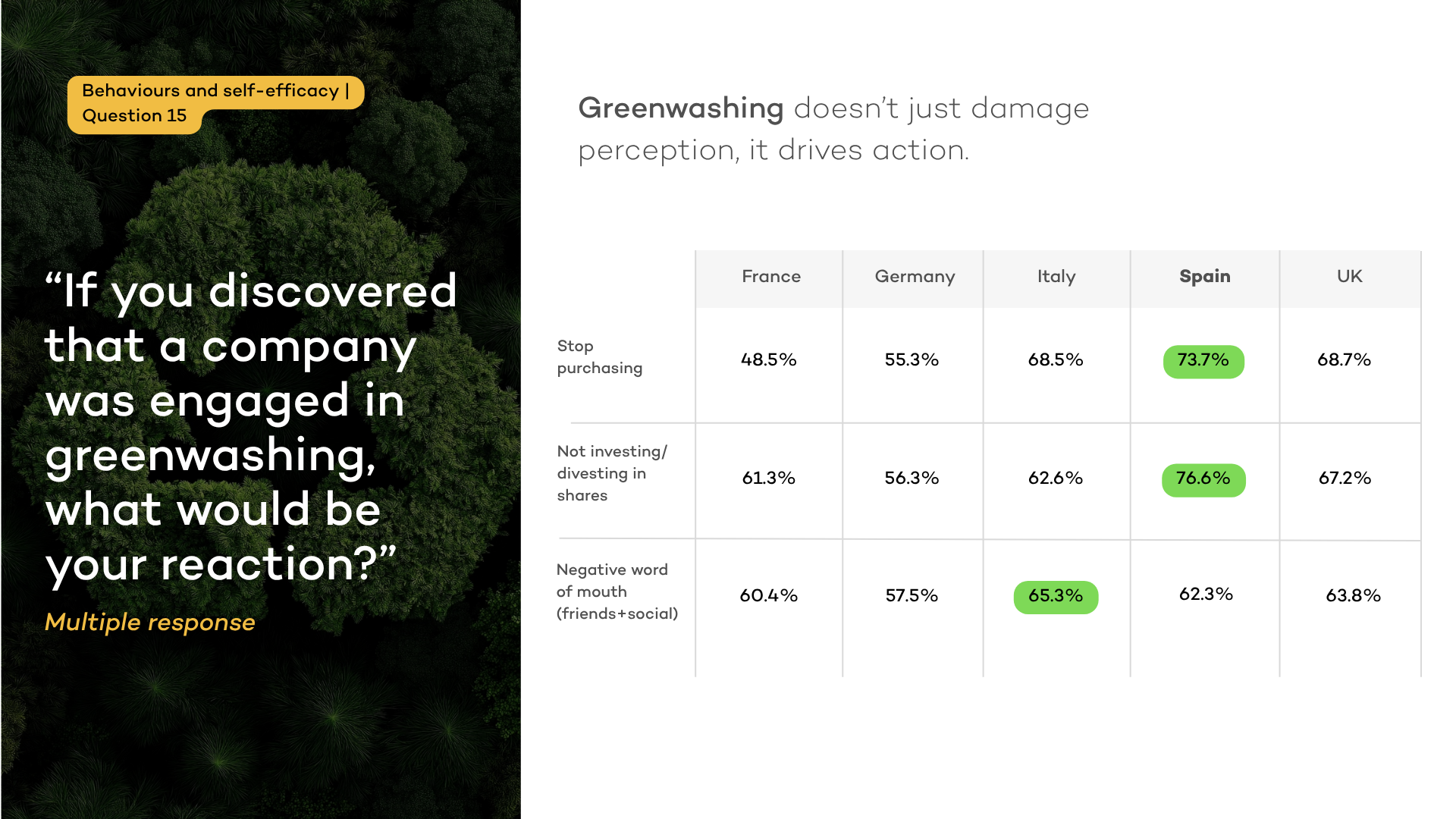
What’s emerging here is something bigger than consumer preference. Sustainable boycotting is becoming a form of political expression — a way for citizens to enforce accountability when institutions feel too slow, too distant, or too compromised to do it themselves.
The Sustainability Say-Do Gap: Why Belief and Behaviour Don’t Match
At the heart of the study is a measure we built into the research from the very beginning — not discovered in the data after the fact, but designed into the questionnaire. The so-called Say-Do-Gap: the distance between what people say they believe and what they actually do.
«In my own small way, my choices can make a difference for the environment.»
We asked separately about intentions and behaviours. We included a dedicated section on perceived barriers to change. We wanted discrepancies to emerge as findings, not artefacts.
And emerge they did.
Germany — the country that feels most informed, most convinced of its own impact — records the highest Say-Do-Gap across the five countries. 75.9% of Germans believe their choices can make a difference for the environment. But only 62.8% took at least one concrete action the week before the interview. A gap of 7.7 percentage points. Between conviction and behaviour. Between beliefs and habits.
Italy tells a different story. Italians recycle and reduce food waste at rates comparable to their European neighbours. But when sustainability requires economic effort — conscious purchasing, avoiding fast fashion, reducing private vehicle use — Italy ranks last across the board. The gap here is not between saying and doing. It’s between the easy actions and the costly ones.

The generational paradox: younger Europeans act more
We tend to tell simple stories about generations and sustainability. Young people care. Older people resist. The future belongs to those who grew up with Greta Thunberg on the news and plastic straws banned from their cafeterias.
Yes, younger Europeans (18–34) act more. But they believe less — less convinced that their individual choices actually make a difference. Older generations (55+) are the opposite: deeply convinced of their own impact, and far less likely to have done anything about it in the past week. Action and belief, it turns out, don’t always travel together.
Public Trust in Government Sustainability Action Remains Weak
Sustainability has become a fixture of government agendas across Europe. Directives, transition plans, the institutional machinery is in motion. And yet, when asked to rate their own government’s commitment to environmental issues, the citizens across all the 5 countries consider it inadequate.
In Germany, 64.2% consider it inadequate. Italy follows at 63.6%, France at 58.5%, Spain at 53.1%, the UK at 50.4%. In no country does more than a third of the population consider government action adequate.
As for who should do more — the most common answer across all five countries is “everyone equally.” Governments, companies, and citizens alike. No one is off the hook.
Why Public Opinion Data Should Not Stay Inside a Desktop Folder
We are a data collection company. We don’t write policy. We don’t run campaigns. We are not here to convince anyone to live more sustainably.
What we do is listen. Carefully, rigorously, at scale. And when you listen to 5,000 people across five countries with the right questions and the right methodology, something happens: the noise clears. Patterns emerge. The distance between what people say and what they do becomes measurable — and measurable means actionable.
That’s what data is for.
If you’d like to explore the full report — country by country, get in touch. We’ll send it over.
Other Articles
-
 CATI26 February 2026
The operational challenges of telephone market research
For many business leaders, the gap between needing a clear answer and securing reliable, actionable data can feel daunting. How do you bridge it? Often, the solution lies in choos... -
 CATI22 January 2026
How CATI is Evolving: An expert interview on the future of telephone research
Reaching the right people for quality insights has never been more challenging. In market research, telephone interviews have long been a cornerstone precisely because they offer c... -
 CATI14 November 2025
What makes Sample Quality actually reliable
Why “hitting quotas” doesn’t mean you reached the right people—and how to ensure your sample delivers credible insights. You’ve commissioned a study targeti...